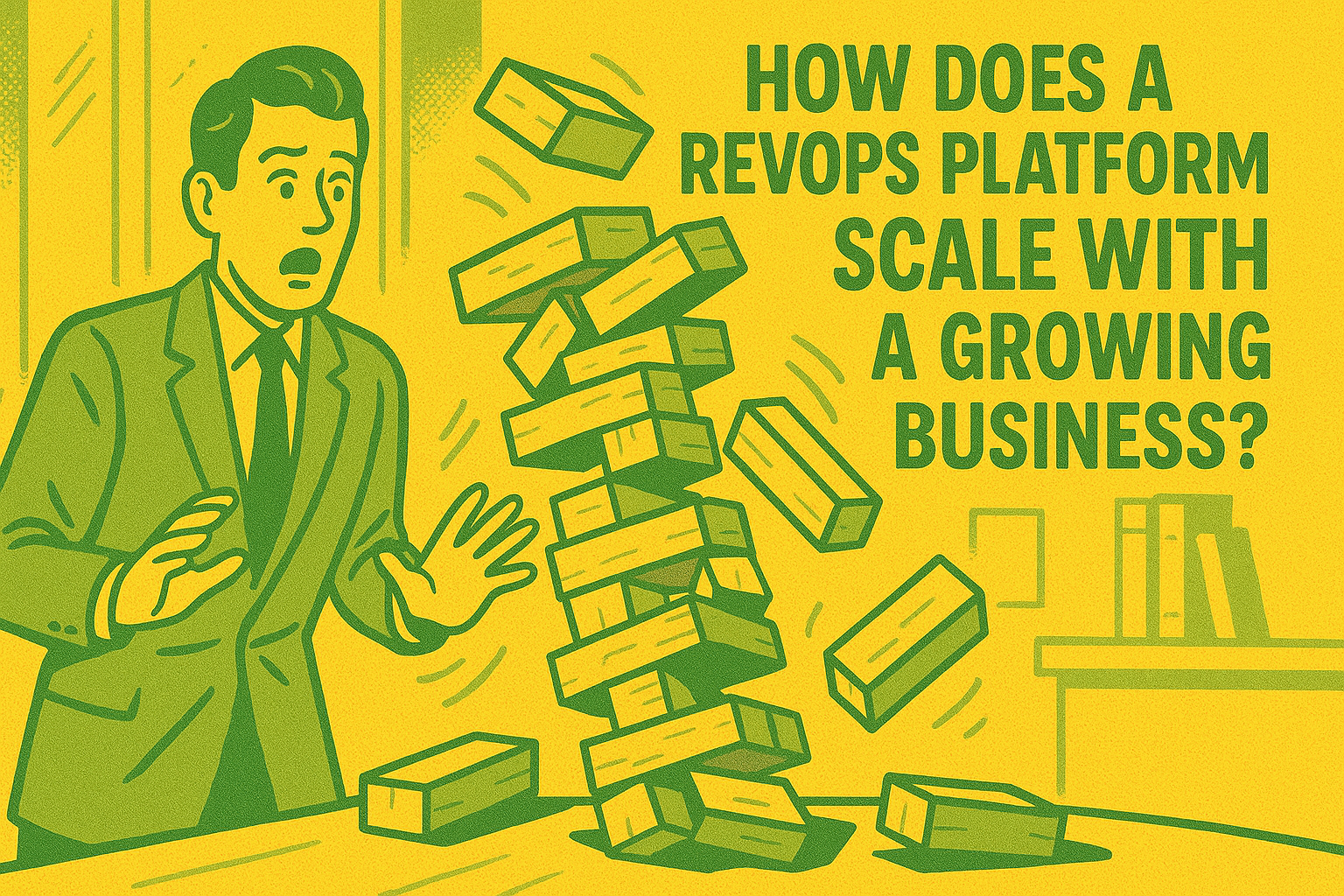

The Big Problem: Your Company Is “Scaling” the Same Way a Jenga Tower Does — Taller, Shakier, and One Move Away From Catastrophic Collapse
Let’s start with a universal truth no founder wants to admit: most companies don’t scale — they stretch, like a cheap rubber band being asked to hold together an entire Costco cart. Everything looks fine from a distance, but the moment pressure increases, there’s a sharp pop and suddenly you’re dealing with flying canned goods and existential dread.
This is exactly how revenue operations behave as a business grows. What worked at $2M ARR collapses at $5M. What worked at $5M disintegrates at $10M. What worked at $10M spontaneously combusts at $20M. And what worked at Series A turns into a flaming parade float by the time you reach Series C.
Your processes don’t break because your people are bad — they break because nothing in your current system was ever designed for scale. Your CRM becomes a scrapyard of renegade fields and broken workflows. Your marketing automation runs like a carnival ride built by interns. Your analytics layer is eight dashboards that claim eight different truths. Your sales process has mutated into multiple contradictory religions. CS is drowning in onboarding chaos. Finance is duct-taping ARR numbers with spreadsheets like back-alley surgeons. Product data might as well live in Narnia.
The reason scaling hurts is because your systems weren’t architected to grow. They were jury-rigged to survive.
A RevOps platform doesn’t help you survive growth.
It helps you outgrow your competitors without burning your own house down.
The Clear Definition: What “Scalability” Actually Means
Scalability means your revenue systems, processes, workflows, data structures, and lifecycle logic expand smoothly as your business grows — without needing to reinvent operations every six months or hire an army of ops people to clean up preventable chaos.
Scalability is not “adding more tools.”
Scalability is not “hiring more reps.”
Scalability is not “throwing AI at the problem and hoping it doesn’t explode.”
Scalability is compounding operational integrity.
When a company scales, everything becomes bigger — customer volumes, deal complexity, team count, product surface area, onboarding complexity, reporting needs, and the number of Slack channels screaming “URGENT.”
If your architecture can’t handle it, growth becomes a liability.
A RevOps platform turns that liability into momentum.
Why Your Current Systems Will Absolutely Fail at Scale (Even If You’re Pretending They Won’t)
Growth exposes everything you didn’t fix earlier.
Your CRM feels fine when you have 200 accounts — but collapses when you have 2,000.
Your marketing automation seems manageable when you run five campaigns — but becomes a labyrinth when you run 50.
Your sales process holds together with glue and prayer at a 10-person team — but becomes civil war when you hit 40.
And the biggest lie companies tell themselves?
“We can fix it later.”
Later never comes.
Later is the land where good KPIs go to die.
Later is where your ops team quits.
The truth is that your systems are not bending — they are cracking.
Why?
Because your architecture is built on sequential decisions instead of holistic design.
Because your data is ungoverned, unvalidated, and unstandardized.
Because your workflows depend on human memory instead of automation.
Because your departments operate like rival tribes sharing one broken radio.
Because your reporting is backward-looking instead of model-driven.
Because your tools multiply faster than rabbits.
Scaling doesn’t create new problems.
Scaling magnifies existing ones.
A RevOps platform is the only structural solution that grows with you instead of against you.
How a RevOps Platform Actually Scales With Your Business
A RevOps platform scales by building foundational intelligence into your entire revenue engine. Instead of duct-taping solutions onto existing problems, it creates an operational framework where growth becomes easier — not harder.
The platform standardizes every lifecycle stage so your process doesn’t mutate at scale like radioactive bacteria. It enforces validation rules so your data doesn’t become a sewer of chaos. It unifies signals from every tool so customer insight increases with scale instead of disappearing under noise. It automates workflows that previously required human babysitting, meaning you don’t have to hire ten new analysts every time your pipeline doubles.
And because the RevOps platform becomes the operational brain, scaling stops feeling like balancing a refrigerator on a skateboard. You grow, and the intelligence grows with you. You add new teams, and the platform absorbs them. You expand regions, and the processes replicate. You adjust ICPs, selling motions, territories, or product lines, and the operational model adapts without detonating everything below it.
In other words:
the platform grows, so you don’t break.
Why a RevOps Platform Is the Only Architectural Solution That Actually Scales Revenue
Let’s be honest about the alternatives:
You cannot scale by adding more people.
You cannot scale by adding more tools.
You cannot scale by adding more spreadsheets.
You cannot scale by adding more panic.
You scale by adding structure, visibility, governance, and automation.
A RevOps platform delivers:
Revenue intelligence that improves with volume
Processes that stabilize instead of unravel
Forecasting that gets more accurate with scale
Customer visibility that sharpens as complexity increases
Systems that reinforce one another
Teams that collaborate instead of collide
Scaling is not about doing more.
Scaling is about eliminating friction.
And friction is exactly what a RevOps platform is engineered to kill with extreme prejudice.
A Real-World Story: The Startup That Grew Too Fast and Lived to Tell the Tale
Picture a startup that hit $10M ARR with raw talent, caffeine, luck, and a patchwork ops structure held together by one extremely stressed RevOps manager named Emily. Everything looked great — on the surface. But beneath the surface, every system was one bad quarter away from implosion. CS had no process consistency. Sales stages meant nothing. Marketing produced leads that vanished into black holes. Product signals lived only in engineering’s brain. Finance pulled ARR numbers from competing spreadsheets like a magician with trust issues.
Then they raised a Series B — and chaos multiplied. More reps. More customers. More regions. More products. More dashboards. More friction. More confusion. More Emily in tears.
Implementing a RevOps platform was their turning point.
It created structure where chaos had lived.
It created visibility where darkness had ruled.
It created automation where manual suffering had been normalized.
It created governance where whim had dictated process.
Twelve months later, they scaled to $25M ARR, but the systems didn’t break.
Not because the team worked harder —
but because their architecture finally worked with them instead of against them.
This is scalability.
Not “working more.”
Working intelligently at scale.
The Final Truth
Most companies don’t fail because they can’t grow.
They fail because they grow faster than their systems can handle.
A RevOps platform scales with your business by creating unified data structures, automated workflows, lifecycle consistency, governance, predictability, and real-time intelligence — ensuring your operations strengthen as your company expands instead of collapsing under the weight of its own success.
Scale should amplify strength, not weakness.
A RevOps platform ensures it does.
Without it, you’re stacking dynamite under your future.
With it, you’re building the runway for sustainable, explosive, unstoppable growth.