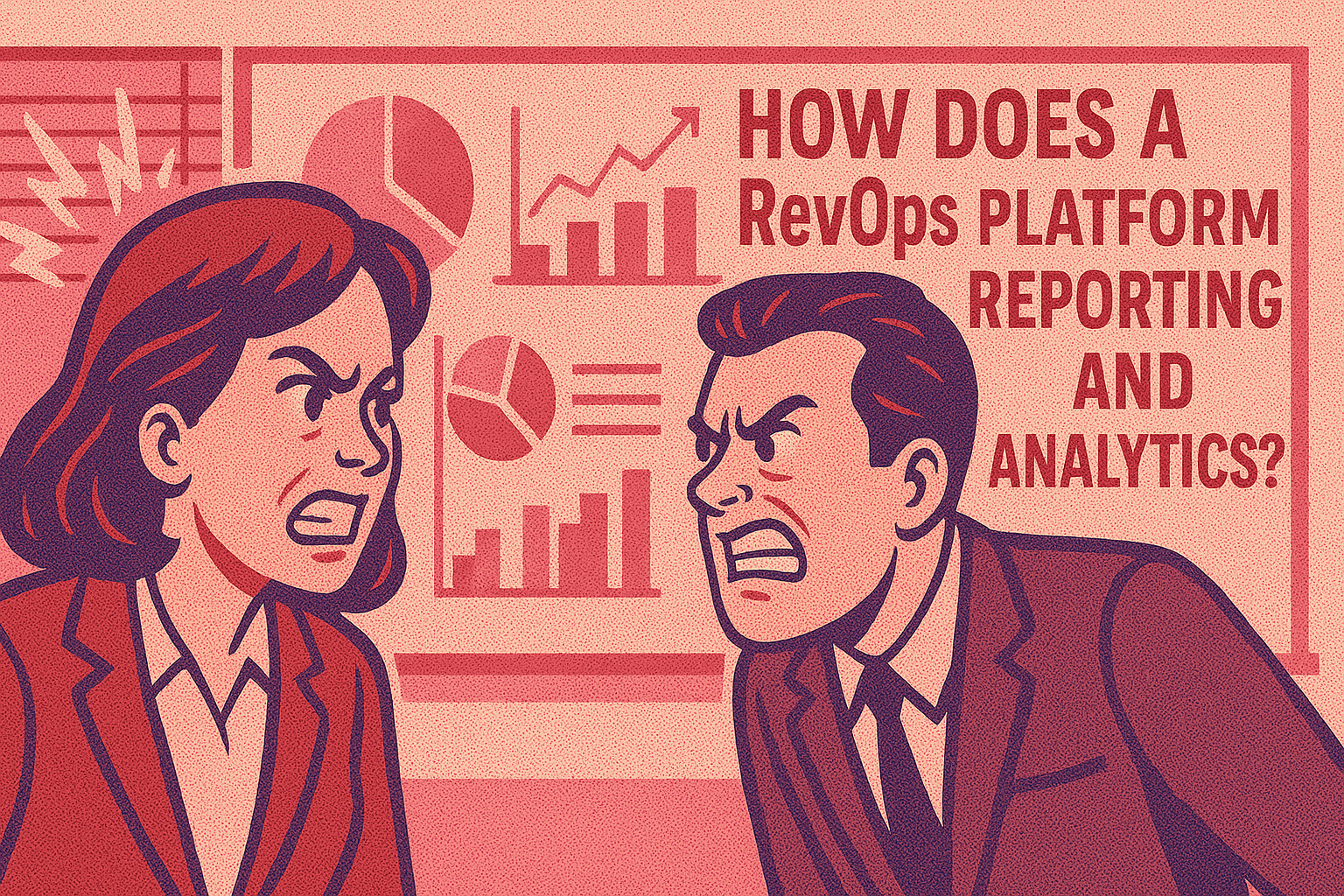

The Big Problem: Your Reporting Isn’t “Confusing”—It’s a Fraudulent Work of Art
Let’s tell the truth nobody wants to say out loud: reporting in most organizations is a tragicomic performance piece. Every department insists they have “really solid dashboards,” yet none of those dashboards agree with each other. Marketing has reports showing pipeline influence so optimistic it borders on fiction. Sales has reports showing momentum so fragile it collapses under the weight of a follow-up question. CS has reports that technically qualify as “health scores,” assuming you define “health” as “vibe-based.” Finance has reports that, in theory, should reconcile all of this—but somehow never actually do.
And leadership? Leadership is staring at six different dashboards, three spreadsheets, a BI tool no one knows how to operate, and a PowerPoint from last quarter that contradicts everything. Their face says it all:
“Are we doing well? Are we doing poorly? Why don’t these numbers match? And why does every meeting feel like we’re solving a murder mystery?”
The answer is simple:
Your reporting isn’t broken because teams don’t try.
Your reporting is broken because your systems refuse to cooperate.
Data is scattered. Definitions are inconsistent. Tools aren’t integrated. Lifecycle stages don’t line up. Attribution isn’t standardized. User behavior isn’t surfaced. Forecast categories are subjective. And dashboards are built on top of sandcastles pretending to be foundations.
What you have isn’t reporting.
What you have is a digital hallucination.
That is the chaos a RevOps platform was invented to annihilate.
The Clear Definition: What “Improved Reporting and Analytics” Actually Means
Improved reporting and analytics mean having reliable, unified, real-time insights built on clean data, consistent definitions, and connected lifecycle signals—allowing teams to understand what is happening, why it’s happening, and what they should do next.
In Deadpool terms:
It means your dashboards stop gaslighting you.
Why Reporting Fails (Even When Smart People Build It)
Most reporting doesn’t fail because the analysts are incompetent. It fails because the system forces them to perform data gymnastics that break every bone in the BI skeleton.
Marketing tracks leads in one system, while Sales tracks pipeline in another. CS tracks adoption in a third, Product tracks usage in a fourth, and Finance tracks ARR in spreadsheets so large they should qualify for their own zip code. None of these systems speak the same language. None of them pull from the same truth. None of them define lifecycle stages the same way. None of them update in real time.
That means your reports are Frankensteins—patched together, unpredictable, and deeply misunderstood.
Worse, every team has different definitions of success:
Marketing thinks a lead is “high quality” because someone clicked an email.
Sales thinks a lead is “high quality” only if they schedule a call.
CS thinks a customer is “healthy” if they haven’t filed a support ticket recently.
Finance thinks a customer is “healthy” only if they renew.
Leadership thinks “healthy” means “everything is fine and please no surprises.”
You cannot build reporting on top of mutually incompatible realities.
A RevOps platform fixes this by replacing subjective reporting with unified, objective truth.
How a RevOps Platform Actually Improves Reporting and Analytics
A RevOps platform doesn’t just clean data—it rebuilds the entire reporting environment so that every dashboard, every metric, and every analysis pulls from the same system of record, the same lifecycle logic, and the same truth about the customer.
This is the difference between:
“I think this number is right…”
and
“I know this number is right because the system enforces it.”
With every team connected into the same operational brain, reporting becomes accurate by design. Pipeline stages are enforced based on real buyer behavior. Product usage is surfaced automatically. Health scores are calculated consistently. Forecast categories reflect actual momentum. Marketing attribution is tied to revenue, not wishful thinking. CS insights flow into expansion modeling. Finance doesn’t have to reconcile numbers manually because the revenue engine is actually aligned.
Suddenly, reporting stops being a never-ending archaeology project and becomes a real-time intelligence system.
Analytics become powerful because the inputs are finally trustworthy.
Why Reliable Reporting Transforms the Entire Organization
Accurate reporting is the difference between guided strategy and blind optimism. When reporting becomes reliable, the business becomes smarter almost instantly.
Leadership can make decisions confidently instead of guessing.
Sales knows exactly which actions increase win rates.
Marketing sees which channels produce revenue—not just engagement.
CS detects churn risk early.
Product sees adoption patterns that drive retention.
Finance forecasts revenue with terrifying precision.
RevOps stops spending their days cleaning up data disasters.
The entire revenue engine gets faster, leaner, and more predictable.
Reliable reporting doesn’t just inform decisions—it transforms decisions.
It moves the company from reactive to proactive, from chaotic to coordinated, from confused to aligned.
This is why improved reporting isn’t just a “nice-to-have analytics upgrade.”
It is the backbone of operational maturity.
A Real-World Story: The Company Whose Dashboards Lied to Them (Until RevOps Intervened)
There once was a company that proudly claimed to be “data-driven.” They had dashboards everywhere. Dashboard for pipeline. Dashboard for marketing. Dashboard for churn. Dashboard for revenue. Dashboard for product usage. Dashboard for dashboard usage. If dashboards were currency, they were wealthy.
But every dashboard painted a different picture.
Marketing’s dashboard said they were crushing it.
Sales’ dashboard said they were starving.
CS’s dashboard said customers were “mostly fine.”
Finance’s dashboard said revenue was declining.
Product’s dashboard said usage was increasing.
Leadership’s dashboard said, “Oh God, what is even happening?”
Then they implemented a RevOps platform.
Within weeks, the platform exposed the misalignments:
Marketing was tracking leads that never reached the CRM.
Sales had opportunities in the wrong stages.
CS was marking customers healthy based on outdated intel.
Product usage wasn’t tied to accounts correctly.
Finance was forecasting based on stale data.
Dashboards were pulling from different tools, different fields, and different timeframes.
Once the RevOps platform unified the lifecycle:
All reporting aligned.
All teams saw the same truth.
All decisions finally made sense.
Leadership stopped asking, “Which dashboard should we believe?”
Because suddenly there was only one truth.
This is not magic.
This is what happens when systems are architected intentionally instead of chaotically.
The Final Truth
You cannot make intelligent decisions on top of dumb data.
You cannot create accurate dashboards with inconsistent definitions.
You cannot build analytics on fragmented systems.
You cannot scale revenue when reporting behaves like a pathological liar.
A RevOps platform fixes reporting by fixing the system that reporting depends on.
It removes the inconsistencies.
It eliminates the manual cleanup.
It unifies the lifecycle.
It enforces definitions.
It centralizes truth.
When reporting becomes reliable, the entire company becomes reliable.
And the difference between companies that scale and companies that stall often comes down to a single capability:
The ability to see the truth clearly and act on it immediately.
A RevOps platform gives you that truth.
Not the truth you want.
Not the truth you imagine.
Not the truth that makes your quarterly meeting feel warm and fuzzy.
But the actual truth—
the truth that unlocks operational clarity, revenue intelligence, and scalable growth.