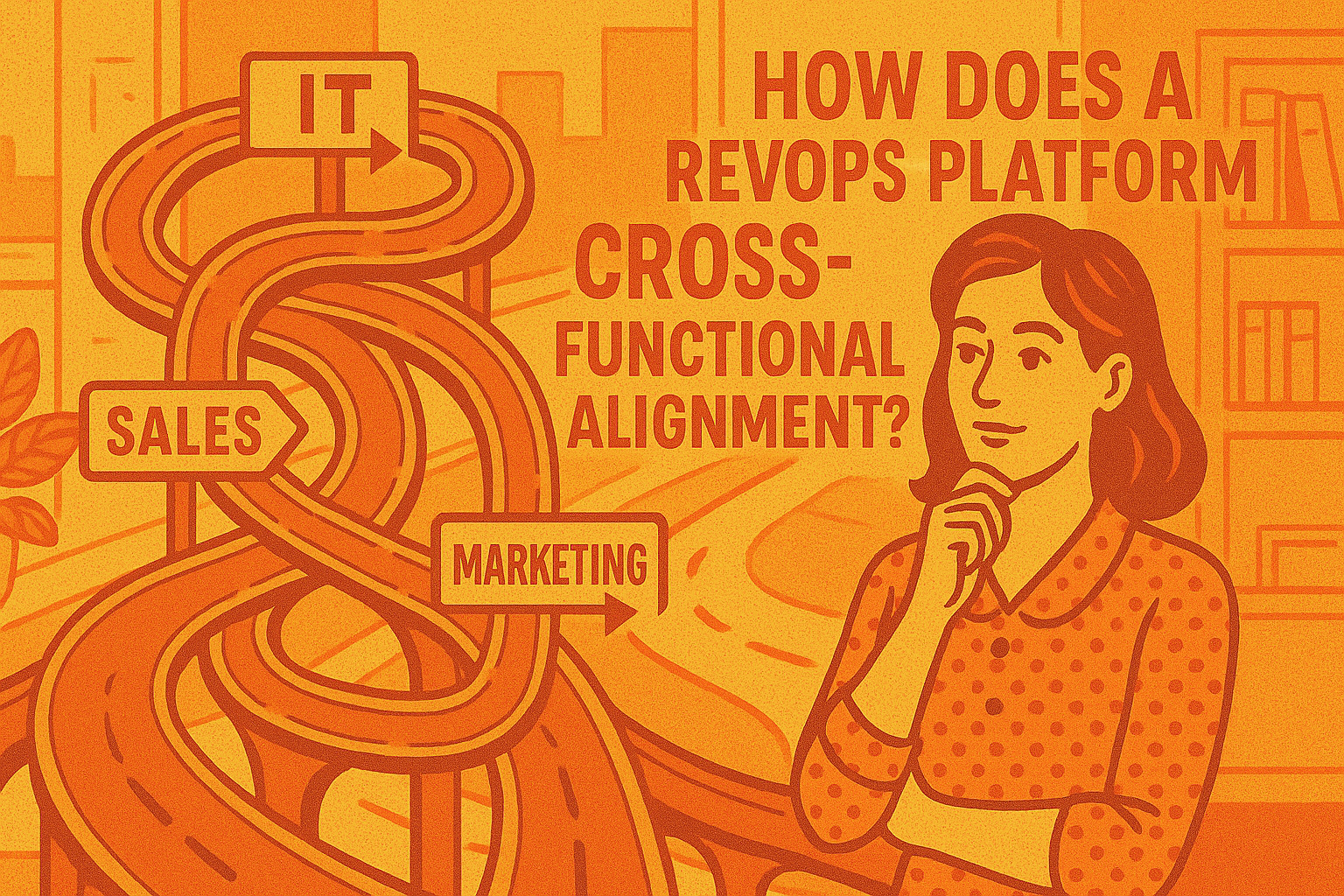

The Big Problem: Your Teams Aren’t “Misaligned”… They’re in a Full-On Cold War With Better Branding
Let’s get one thing out of the way: most companies talk about “cross-functional alignment” the same way families talk about “our Thanksgiving dinner dynamic.” Everyone says it’s mostly fine while secretly praying no one brings up pipeline, attribution, or “why marketing spends so much on brand campaigns.” Sales thinks Marketing is out of touch. Marketing thinks Sales is allergic to CRM hygiene. CS thinks Sales sells fever dreams. Finance thinks everyone is lying. Product thinks no one understands their timelines. And leadership thinks alignment can be achieved through vibes, slogans, and a slide deck with arrows connecting boxes.
Spoiler: it cannot.
Your teams aren’t misaligned.
They’re operating in parallel universes, each with its own laws of physics, its own version of the truth, and its own definitions for words like “qualified,” “active,” “at risk,” and “pipeline.” If multiverse movies have taught us anything, it’s that parallel universes always end in interdimensional catastrophe unless someone forces a merging of timelines.
That someone is your RevOps platform.
Because your CRM sure as hell isn’t doing it.
The Clear Definition: What Cross-Functional Alignment Actually Is
Cross-functional alignment is a shared operational reality across Sales, Marketing, CS, Finance, and Product — powered by unified data, consistent lifecycle definitions, synchronized workflows, and real-time visibility into the customer journey that removes ambiguity, finger-pointing, and interpretive dance forecasting.
In shorter terms:
Alignment means everyone stops making up their own version of the truth.
It’s the moment your revenue engine stops sounding like a group project where one person does everything and everyone gets the same grade. It’s where teams finally behave like parts of the same organism instead of poorly paid gladiators fighting for headcount and political oxygen.
Why Your Teams Are Actually Misaligned (And Why “Communication” Has Nothing to Do With It)
Companies love to say misalignment comes from “lack of communication.” That’s adorable. Like blaming a burning building on “lack of cinnamon.” Your teams communicate constantly — that’s half the problem. They communicate messy, contradictory, duplicative data across systems that don’t match, workflows that don’t sync, and definitions that were invented by some middle manager in 2019 and never updated again.
Marketing says a lead is qualified.
Sales says the lead is trash.
CS says the customer came in unqualified.
Finance says the ARR was overreported.
Product says no one logged the usage signals.
Leadership says “Why doesn’t anyone agree on anything?”
Revenue teams say “Because none of this stuff matches.”
Misalignment happens because everyone is looking at different data, in different tools, with different rules, and drawing different conclusions. You can’t “communicate your way out” of structural inconsistency.
You need a system that forces consistency.
Yes, forces.
Because left alone, teams do what humans always do: create their own kingdoms, their own spreadsheets, their own workflows, and their own secret backchannel Slack groups where they complain about the other kingdoms.
A RevOps platform ends the feudal revenue era.
How a RevOps Platform Actually Improves Cross-Functional Alignment (Without Needing a Group Hug)
A RevOps platform binds your revenue ecosystem together not through motivational posters or inspirational leadership offsites, but through shared truth enforced at the system level. Suddenly, lifecycle stages aren’t “whatever the rep thinks they are today” but universally defined gates everyone agrees on. Marketing can no longer pass MQLs that Sales rejects because the platform validates their readiness. Sales can’t close deals into databases missing crucial onboarding info because the platform won’t let the opportunity progress. CS doesn’t start blind because the system pulls the entire history and hands it to them without needing a séance.
Finance doesn’t recalculate ARR manually because the platform syncs it correctly.
Product doesn’t guess which customers are engaged because the platform shows it.
Leadership doesn’t ask “which dashboard is right?” because everything is one system of truth.
Alignment doesn’t happen through meetings.
It happens through architecture.
When the system forces shared definitions, shared data, shared workflows, and shared visibility, teams finally stop arguing about reality and start acting on it.
Why Alignment Isn’t “Nice to Have” — It’s the Whole Game
Misalignment isn’t a cultural issue.
It’s an economic one.
Misalignment slows deals.
Misalignment breaks customer experience.
Misalignment cuts win rates.
Misalignment blindsides forecasting.
Misalignment frustrates top performers.
Misalignment exhausts bottom performers.
Misalignment creates rework, confusion, and political resentment.
Alignment is not soft-skills fluff.
It is revenue infrastructure.
When revenue teams share truth, they make better decisions.
When they share process, they move faster.
When they share data, they perform smarter.
When they share context, customers feel the difference.
Alignment is the difference between a revenue engine that scales and a revenue engine that wheezes.
A RevOps platform makes alignment the default state, not the aspirational one.
A Real-World Story: The Company That Accidentally Discovered Alignment (And Then Scaled Like Hell)
Let me tell you about a SaaS company where every department believed they were the lone heroes in a tragic epic. Marketing thought Sales was sabotaging them. Sales thought Marketing was feeding them leads that looked like they were generated by shaking a random LinkedIn tree. CS thought Sales was out there promising immortality and unlimited storage. Finance thought everyone was lying on purpose. Product thought no one appreciated their timelines. Leadership thought teams simply needed to “work better together.”
Then they deployed a RevOps platform.
Like magic — but actually like technology — lifecycle data became consistent. MQLs came with context. Sales handoff packages stopped being blank fields and broken dreams. CS received a full history of every interaction. Marketing finally saw which campaigns drove revenue, not just clicks. Product saw usage signals mapped to renewals. Finance saw revenue truth without needing an exorcism. Leadership saw dashboards that didn’t contradict each other like bickering siblings.
Suddenly the teams weren’t fighting. They were collaborating. Not because they grew emotionally, but because the system removed all the ambiguity that fueled conflict.
Teamwork isn’t a personality trait.
It’s an information environment.
The Final Truth
Cross-functional alignment isn’t a mystery. It’s not a trust exercise. It’s not solved by better meetings, better managers, better messaging, or better teamwork posters with mountaintops on them.
Cross-functional alignment happens when every revenue team operates from the same truth — enforced by a RevOps platform that standardizes data, lifecycle, workflow, and visibility at the system level.
Alignment isn’t a “nice to have.”
Alignment is the foundation of revenue velocity.
With a RevOps platform, alignment becomes inevitable.
Without one, misalignment becomes destiny.
And only one of those futures ends with your teams hugging instead of plotting each other’s downfall.