
Every company swears they believe in “alignment.” It’s plastered in onboarding decks. It decorates conference room walls. Leaders invoke it during all-hands meetings the same way politicians invoke “unity” before doing absolutely nothing to support it. Alignment is the corporate version of flossing: everyone agrees it’s important, almost no one does it consistently, and most people lie about it when questioned directly.
But the truth is far darker. GTM teams aren’t just misaligned—they are actively siloed, structurally separated by tools, processes, workflows, incentives, definitions, communication patterns, and cultural norms that ensure chaos and confusion for generations to come. Marketing launches campaigns Sales knows nothing about. Sales closes deals CS learns about from the customer. CS identifies expansion opportunities that no one ever routes back to Sales. Finance builds forecasts entirely divorced from reality. Product receives feedback that contradicts everything Sales claims customers need. And RevOps, God bless them, stands in the middle of it all like a referee in a knife fight.
This is not alignment.
This is multidepartmental Hunger Games.
And yet every team thinks they are the reasonable one. Marketing thinks Sales is ungrateful. Sales thinks Marketing is delusional. CS thinks everyone undervalues the post-sale experience. Finance thinks everyone else is reckless. Product thinks no one “understands the roadmap.” The CEO thinks everyone should just “collaborate more,” as if collaboration were a button people forgot to click.
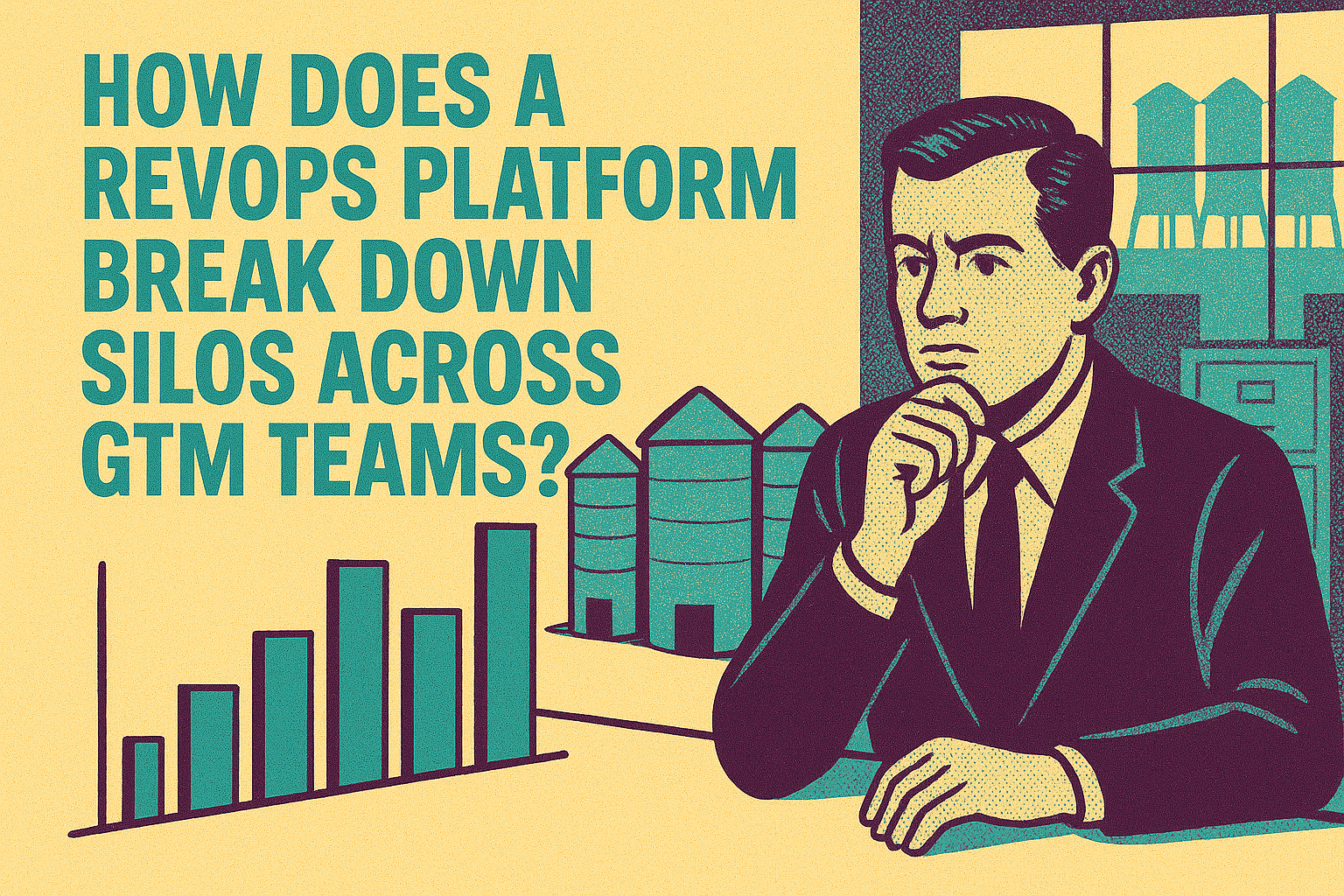
This is the problem at the root of all RevOps dysfunction: silos. Thick ones. Wide ones. The kind you could build a bomb shelter out of. Silos don’t just slow companies—they sabotage them.
Enter the RevOps platform, the only known cure for interdepartmental chaos that doesn’t involve firing half your staff or replacing everyone with a fleet of Roombas that respond to Slack messages.
The Big Problem: GTM Silos Exist Because Systems, Data, and Processes Don’t Talk to Each Other
Let’s be brutally honest. Teams don’t operate in silos because they hate each other. They operate in silos because their systems are siloed. Their data is siloed. Their processes are siloed. Their definitions are siloed. Their visibility is siloed. Even their Slack channels are siloed.
Marketing uses MAPs, analytics tools, attribution dashboards, intent signals, UTM parameters, and campaign automation. Sales uses the CRM, sequencing tools, pipeline dashboards, forecast spreadsheets, and a carefully curated collection of excuses. CS uses a customer success platform, ticketing system, health scoring tool, renewal tracker, NPS software, and half a dozen Google Docs containing institutional knowledge. Product uses analytics tools and surveys no one else can interpret. Finance uses spreadsheets whose lineage predates the existence of TikTok.
These systems don’t connect. They don’t share truth. They don’t share context. They don’t share insights. They don’t share definitions. They barely acknowledge each other’s existence, like divorced parents who pretend the other doesn’t exist as long as the kids aren’t asking questions.
A RevOps platform doesn’t just break down silos.
It removes the conditions that created them in the first place.
The Clear Definition: What It Means to ‘Break Down Silos’
A RevOps platform breaks down GTM silos by unifying data, aligning processes, centralizing workflows, enforcing consistent definitions, enabling shared visibility, and orchestrating cross-functional collaboration in a single operational ecosystem that forces teams to operate as one revenue engine instead of four competing departments.
In Deadpool English:
It takes your warring factions, throws them into one room, welds the doors shut, and says, “Figure it out, nerds.”
Except nicer. And with dashboards.
Why Silos Form (It’s Not Because People Are Dumb)
Silos appear when three conditions exist:
1. Each team has different tools.
This means Sales lives in CRM land, Marketing lives in automation land, CS lives in health-score land, Finance lives in Excel land, and none of them speak the same language.
2. Each team has different incentives.
Marketing gets rewarded for leads.
Sales gets rewarded for deals.
CS gets rewarded for renewals.
Finance gets rewarded for discipline.
Product gets rewarded for not crying.
These incentives contradict each other more often than not.
3. Each team has different definitions of success.
Marketing says a lead is qualified.
Sales says marketing is lying.
CS says the customer wasn’t ever a good fit.
Product says the customer didn’t use the thing correctly.
Finance says all of you need therapy.
Silos aren’t emotional.
They’re structural.
A RevOps platform provides the architecture needed to collapse them.
How a RevOps Platform Breaks Silos (AKA: The Day the Walls Came Down)
1. Shared Data Means Shared Reality
When all GTM data lives in one place, teams lose the ability to create their own version of the truth.
Marketing can no longer say, “We influenced $2M in pipeline” if the platform shows only $600k stuck at early stages. Sales can no longer say, “We don’t get enough qualified leads” if the platform shows a 63% lead neglect rate. CS can no longer say, “This customer was healthy” if the platform shows usage dropped 48 days ago.
A RevOps platform becomes the one reality everyone is forced to confront.
Alignment begins with truth.
2. Shared Definitions Remove Cross-Functional Confusion
Silos love ambiguity.
They feed on it.
They thrive on undefined words and fuzzy handoffs.
A RevOps platform ends this by codifying:
What “qualified” means
What “stage progression” means
What “health score” means
What “renewal risk” means
What “pipeline hygiene” means
What “engagement” means
When definitions stop being subject to interpretation, collaboration becomes… possible.
3. Cross-Functional Workflows Force Teams to Work Together
Marketing doesn’t just hand off leads—they transition them.
Sales doesn’t just close deals—they pass context to CS.
CS doesn’t just escalate issues—they initiate expansion opportunities.
Finance doesn’t just check numbers—they predict revenue health.
A RevOps platform automates the transitions between these teams, ensuring that critical information flows across the lifecycle.
No more “I didn’t know that.”
No more “We never got that info.”
No more “Wait, who owns this?”
No more “This customer didn’t tell us they were unhappy.”
No more “We found out about churn after the fact.”
Workflows become the connective tissue of the GTM body.
4. Mutual Visibility Reduces Finger-Pointing
When teams see each other’s dashboards, behavior changes.
Marketing suddenly knows which leads Sales is ignoring.
Sales sees which customers CS is rescuing from disaster.
CS sees which promises Sales made during discovery.
Product sees usage patterns and adoption blockers without needing a séance.
Finance sees future revenue risks instead of retroactive autopsies.
A RevOps platform creates transparency—
the kind that makes excuses evaporate faster than a budget in Q4.
5. One Customer Journey, Not Three Disconnected Ones
In most companies, the customer journey is actually three journeys:
Marketing Journey → Sales Journey → CS Journey
Each team handles their slice, and no one looks at the lifecycle holistically unless the CEO is yelling.
But a RevOps platform treats the customer journey as a single continuous system that flows across all teams. Everyone sees:
The same signals
The same transitions
The same risks
The same opportunities
The same account history
The same lifecycle moments
It’s the equivalent of installing an air traffic control tower for your entire GTM operation.
Imagine how many planes won’t crash anymore.
Real-World Example: Marketing vs. Sales (The Rivalry That Ends Here)
There once was a company where Marketing and Sales fought so much they could have sold tickets. Marketing insisted they were producing “high-quality leads.” Sales insisted Marketing was “flooding them with garbage.” Both sides were so entrenched in their beliefs they could have started religions.
Then the company implemented a RevOps platform.
Suddenly, they saw:
Marketing leads were fine—Sales just never followed up.
Sales pipeline stalled because the wrong personas were targeted.
Marketing campaigns were optimized for volume, not revenue.
Sales reps frequently skipped discovery, creating churn nightmares.
CS dealt with downstream fallout from bad-fit customers no one screened properly.
Truth is the great peacemaker.
Not because teams suddenly agree—but because the platform shows them what’s real.
Once the walls came down, collaboration began.
Not out of goodwill—
but because the system removed the ability to operate in isolation.
The Final Truth
Silos don’t break themselves.
Culture doesn’t fix this.
Workshops don’t fix this.
Slack channels don’t fix this.
“Communication training” definitely doesn’t fix this.
Only one thing breaks silos:
a system that forces teams to operate as one.
That system is a RevOps platform.
It unifies data.
It aligns processes.
It centralizes workflows.
It standardizes definitions.
It creates shared visibility.
It builds cross-functional accountability.
It eliminates excuses.
It kills ambiguity.
It exposes reality.
And in doing so, it dismantles every structural condition that allowed silos to form in the first place.
A RevOps platform doesn’t just break down walls.
It replaces them with windows.