The Big Problem: Your Revenue Engine Isn’t “Growing”—It’s Surviving on Dumb Luck
Revenue growth is one of those phrases companies love to toss around like confetti at a parade. “We’re focused on growth this year,” they say, as if growth is something that casually appears if you manifest it hard enough. In reality, most companies aren’t “growing” in any strategic sense—they’re stumbling into revenue the way someone stumbles into a coffee table at 2 a.m. in the dark. Deals close, but no one can explain why. Opportunities vanish, but no one tracks when. Purchasing patterns shift, but no one observes how. Customer behavior changes, but no one notices until it’s too late.
The average revenue engine runs on a strange cocktail of optimism, anecdotal evidence, outdated dashboards, Slack rumors, and whatever numbers look least embarrassing right before a board meeting. Meanwhile, leadership confidently proclaims, “We’re scaling!” while every department quietly prays no one asks which systems, processes, or actual data support that claim.
Here’s the uncomfortable truth:
You cannot grow revenue intentionally if you cannot see revenue clearly.
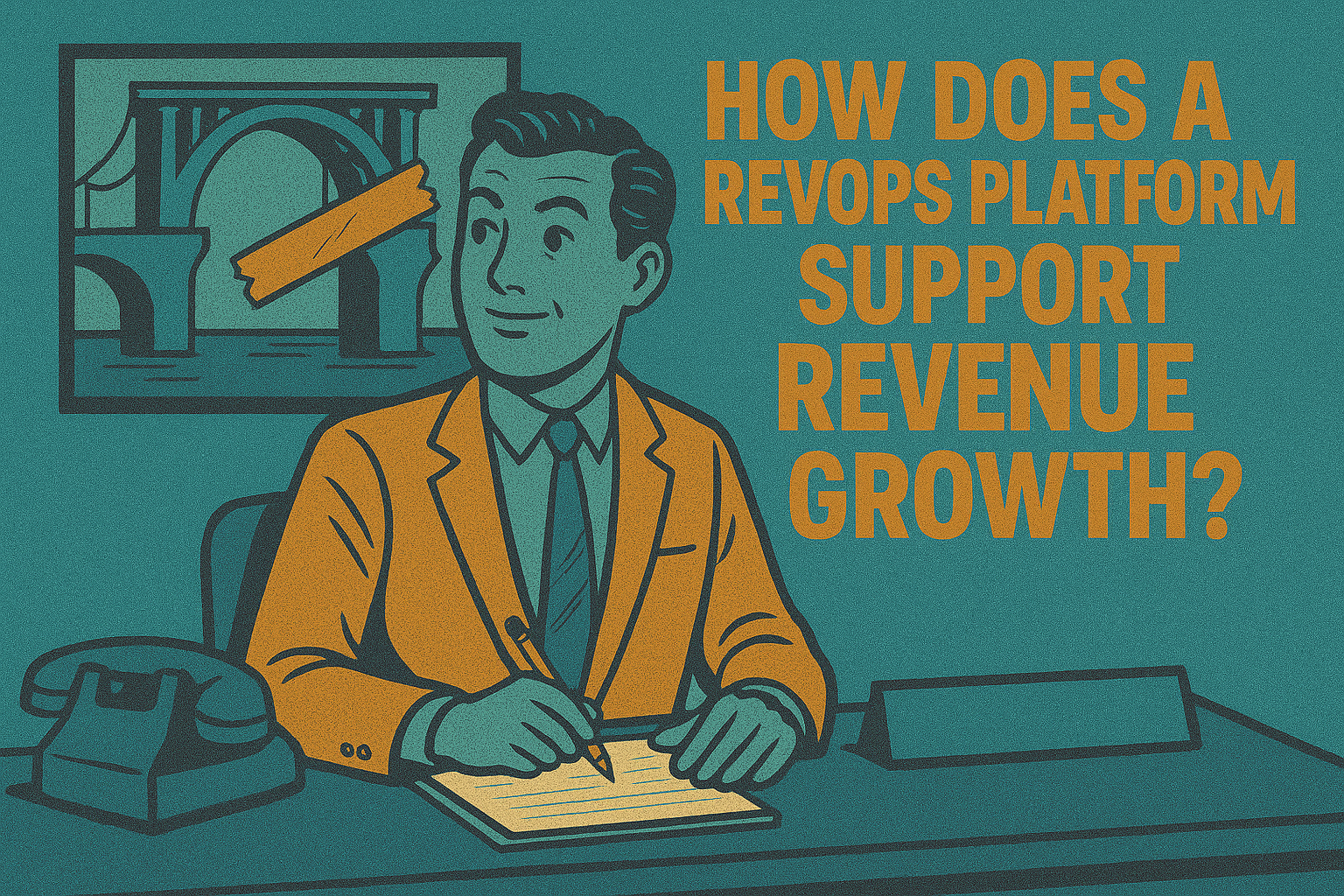
Most companies don’t grow—they accidentally experience growth during good quarters and accidentally lose it during bad ones. There is no repeatable system. No controllable levers. No confidence. No predictability. Just vibes, hustle, and a few heroic individuals holding everything together like duct tape on a collapsing bridge.
This is precisely the nightmare a RevOps platform is designed to end.
The Clear Definition: What Revenue Growth Actually Means
Revenue growth is the consistent, repeatable expansion of new business, customer value, and retention driven by clear visibility, accurate forecasting, operational alignment, predictable processes, and unified lifecycle execution—not luck, not heroics, and definitely not “pipeline feels good this month.”
In plain English:
Growth is not magic. Growth is architecture.
A RevOps platform creates the conditions where growth becomes a system, not an accident.
Why Companies Fail to Grow (Even When They Have Great People)
The biggest misconception in business is that revenue grows because teams “work hard.” Hard work is noble. Hard work is admirable. Hard work is inspiring. But hard work without structure is just sweating in circles until everyone burns out.
Growth fails when teams can’t see the full revenue engine. Sales doesn’t understand Marketing’s reality, Marketing doesn’t understand CS’s reality, CS doesn’t understand Product’s reality, and Finance doesn’t trust anyone’s reality. Every department optimizes locally—never globally. Marketing optimizes for leads, not pipeline quality. Sales optimizes for closes, not customer success. CS optimizes for retention, not expansion potential. Product optimizes for usage, not revenue outcomes.
Everyone works hard on the wrong things.
No one works together on the right things.
This is not a talent issue.
It is a signal issue.
Companies fail to grow because they operate without knowing which actions produce revenue, which friction points destroy revenue, or which patterns determine long-term performance. They react instead of anticipate. They guess instead of analyze. They spend instead of invest. They blame instead of align.
Growth doesn’t die from lack of effort.
Growth dies from lack of insight.
How a RevOps Platform Actually Supports Revenue Growth
A RevOps platform transforms growth from chaos into choreography. It doesn’t give you “more data”—it gives you the right data, connected across the entire customer journey, interpreted in real time, and structured in a way that makes the next move obvious.
Growth begins the moment every team stops operating like separate organisms and becomes one singular revenue engine. Marketing finally sees which channels generate revenue, not just clicks. Sales finally sees which deal patterns lead to wins, not just which prospects answer emails. CS finally sees which accounts are primed for expansion, not just which customers are polite during check-ins. Finance finally sees future revenue signals instead of guessing between spreadsheets.
The RevOps platform unifies all of these views into one truth. And the moment the organization aligns around one truth, revenue aligns with it.
Revenue grows because friction drops.
Revenue grows because cycle times shrink.
Revenue grows because pipeline quality increases.
Revenue grows because expansions surface earlier.
Revenue grows because churn becomes preventable.
Revenue grows because decisions stop being guesses.
In other words:
A RevOps platform doesn’t grow revenue for you—it clears the runway so your revenue can actually take off.
Why Sustainable Growth Requires Systemic Intelligence
It’s easy to mistake “growth” for “more deals.” But growth is actually the byproduct of operational intelligence—knowing what levers to pull and when to pull them. A RevOps platform provides this intelligence by revealing the patterns no individual team could see alone.
It shows Marketing which ICP variations actually convert, instead of which campaigns look good in hindsight. It shows Sales which behaviors shorten cycle times, instead of which reps talk the loudest on pipeline calls. It shows CS which engagement signals predict churn, instead of relying on gut feelings like, “They seemed happy on our last call.” It shows Finance the actual trajectory of ARR, not the optimistic numbers waved around in meetings.
When every decision becomes data-enforced instead of personality-driven, companies stop spinning in circles and start compounding growth.
The real miracle of a RevOps platform isn’t dashboards.
It’s discipline.
And discipline, applied at scale, becomes acceleration.
A Real-World Story: The Company That Discovered Growth Wasn’t a Mystery After All
There was once a mid-stage SaaS company that kept insisting, quarter after quarter, “We’re on the cusp of explosive growth!” Yet mysteriously, the explosion never arrived. Some quarters were good. Others were bad. The board received more excuses than insights: bad timing, bad leads, bad market conditions, bad reps, bad moon phase—pick one.
Eventually, they implemented a RevOps platform because the CEO was tired of relying on vibes. What they discovered was equal parts horrifying and enlightening.
Marketing realized 40% of their spend was driving activity but not pipeline. Sales realized half their “late-stage” deals lacked any real engagement. CS realized expansion opportunities lived in accounts no one had touched in months. Product realized customers who adopted specific features renewed at shocking rates. Finance realized ARR projections were inflated because no one was accurately tagging churn signals.
Once these insights surfaced, growth stopped being a dream and became a roadmap.
Marketing shifted spend to channels with actual revenue impact.
Sales prioritized deals with real behavioral momentum.
CS rebuilt expansion playbooks around measurable signals.
Product doubled down on high-retention features.
Finance forecasted growth with mathematical precision instead of blind hope.
Within three quarters, growth became predictable. Within six quarters, growth accelerated. Within a year, the company stopped praying for good quarters and started engineering them.
The RevOps platform didn’t create growth.
It revealed the path to it.
The Final Truth
Revenue growth is not magic.
Revenue growth is not personality.
Revenue growth is not the consequence of “working harder.”
Revenue growth is the outcome of operational clarity, unified truth, system-enforced consistency, and real-time intelligence across the entire customer lifecycle.
A RevOps platform doesn’t sprinkle fairy dust on your funnel. It builds the infrastructure that turns randomness into repeatability and repeatability into scale. It transforms revenue from an unpredictable byproduct into a deliberate outcome.
If you want growth you can actually count on—not just “good quarters” sprinkled between disappointing ones—then you need a platform that turns chaos into choreography and turns your revenue team from well-meaning improvisers into a synchronized performance.
Growth isn’t something you chase.
Growth is something you build.
A RevOps platform gives you the tools to build it.