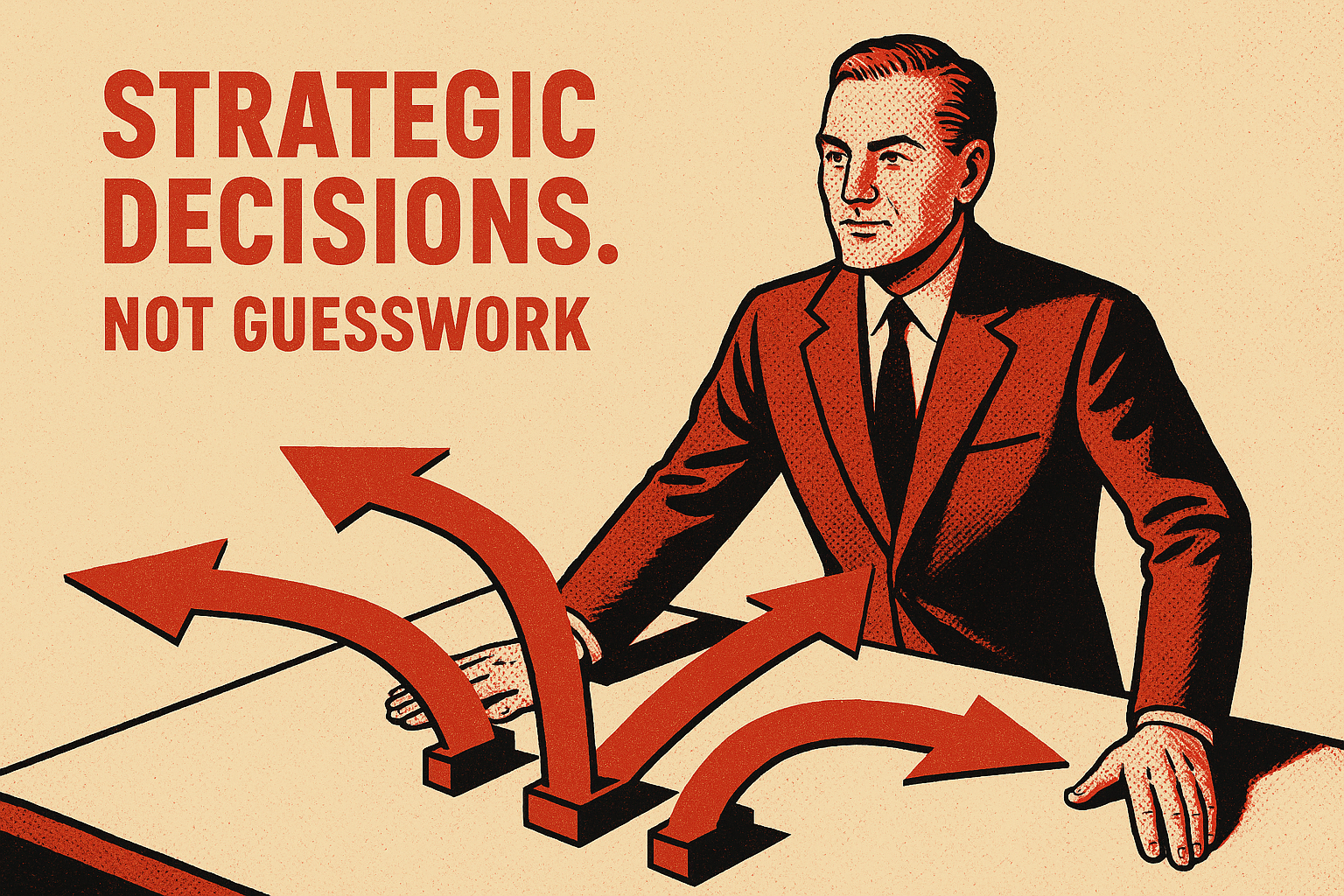

Strategic decision making is often sold as the glamorous part of leadership, where executives sit around a table looking thoughtful, quoting Sun Tzu, and confidently identifying “market opportunities” while sipping designer water. In reality, most strategy meetings resemble a well-funded group hallucination. Each department walks in with its own metrics, its own interpretation of the truth, and its own emotional attachment to whatever narrative makes them look the least guilty. Marketing claims pipeline is booming. Sales insists pipeline is melting. CS says renewals are “stable-ish,” which is the corporate equivalent of saying a relationship is “fine” when someone has already packed a suitcase. Finance sits in the corner clutching numbers so different from everyone else’s that you’d think they came from a parallel universe. Without a RevOps platform, strategic decision making becomes a guessing game performed with absolute confidence and absolutely no alignment.
What a RevOps Platform Actually Does
A RevOps platform improves strategic decision making by centralizing revenue data, standardizing definitions, surfacing lifecycle patterns, modeling outcomes, and giving leadership a unified, trustworthy foundation for deciding where to go next. It turns a foggy, subjective, multi-team tug-of-war into a coherent narrative grounded in reality. The platform becomes the single truth-teller in a room full of hopeful storytellers, and it forces every team to operate from the same shared understanding of what is actually happening across the revenue engine. Instead of five competing dashboards, you have one. Instead of five competing definitions of “qualified,” you have one. Instead of five different explanations for why the quarter slipped, you finally see the actual cause.
Why Strategic Decisions Fail Without RevOps
Most strategic failures are not the result of incompetence; they stem from a lack of visibility. Leaders try to make long-term decisions using data that is incomplete, inconsistent, outdated, or shaped by internal politics. Humans are walking bundles of cognitive bias. They rely on recency bias when the last big deal convinces them a whole new segment is worth chasing. They cling to sunk cost fallacy when a failing initiative gets more budget simply because no one wants to admit the mistake. They fall into confirmation bias by interpreting data in whatever way makes their prior assumptions look brilliant. Without unified data, “strategy” isn’t strategy. It is a confidence contest disguised as planning.
A RevOps platform eliminates this chaos by stitching together Sales, Marketing, CS, Product, and Finance data and showing leadership how the revenue engine performs as a system, not as separate departments defending their turf. It forces consistency. It dissolves ambiguity. It makes assumptions visible—and therefore breakable.
The Power of Shared Truth
When every team sees the same data, the tenor of strategic discussions changes dramatically. Marketing can no longer declare victory because they hit an MQL target if those leads convert like wet cardboard. Sales can no longer insist pipeline is “strong” when half the opportunities have no activity in two weeks. CS can no longer claim accounts are healthy because a friendly stakeholder said something positive during a call last quarter. The RevOps platform integrates lifecycle data, so every team sees the long-term outcomes of their actions—not just the parts they want to celebrate.
This shared truth becomes the backbone of strategic planning. Conversations shift from “Which dashboard is right?” to “Given what the unified data shows, what should we do next?” In the absence of a RevOps platform, each department essentially writes its own version of the company story. With RevOps, there is only one story, and it is the one that actually happened.
A Real-World Example of Strategic Clarity
Consider the company that believed, with religious fervor, that its ideal customer profile was mid-market retail. Leadership loved retail. Marketing targeted retail. Sales chased retail. CS tried their best to onboard retail, often while whispering quiet prayers. Once they implemented a RevOps platform, reality marched in like a tax auditor. The platform revealed that retail customers were expensive to acquire, slow to close, difficult to onboard, low in product adoption, and extraordinarily likely to churn. Meanwhile, segments leadership ignored were thriving: B2B professional services had higher retention, stronger usage, and more expansion than anyone realized.
The strategic pivot that followed saved the company. It wasn’t intuition. It wasn’t someone’s “market read.” It was RevOps clarity. The platform didn’t make leadership smarter. It made the truth unavoidable.
Modeling Outcomes Instead of Guessing
Another advantage of a RevOps platform is its ability to enable scenario modeling. Without RevOps, leaders base plans on slides, intuition, and whichever spreadsheet looks the least horrifying. With RevOps, decisions come from modeled outcomes built on historical performance, segment behavior, product usage data, retention trends, and real conversion rates. Leaders can ask questions like: If we raise prices by 15 percent, what happens to win rates and LTV across segments? If we shift our marketing budget from outbound to product-led motions, what happens to CAC over three quarters? If CS reduces onboarding time by 20 percent, how does expansion revenue behave the following year?
This is strategy upgraded from “educated guess” to “data-backed chess.”
The End of Politics and the Rise of Operational Maturity
One of the most profound cultural impacts of a RevOps platform is the reduction of politics. When every team sees the same numbers and understands the same definitions, persuasive storytelling loses power. Data becomes the referee. People stop debating whether a problem exists and start debating how to fix it. Leaders stop operating defensively and begin operating collaboratively because they no longer fear someone else manipulating metrics to justify their department’s decisions.
Once politics fade and clarity rises, strategic decision making improves almost automatically. The leadership team finally shares a brain instead of fighting over whose brain is correct.
The Bottom Line
A RevOps platform is not a luxury. It is the prerequisite for real strategy. Without it, executives operate in a haze of guesswork wrapped in confidence. With it, they finally understand the revenue engine well enough to steer it with precision. Strategic decision making becomes grounded, disciplined, and informed—powered not by vibes, but by verified reality. And yes, it does this while Deadpool stands in the background making sarcastic commentary about every assumption you used to cling to.