
The Big Problem: Your Tech Stack Isn’t a “Stack”—It’s a Digital Hoarder House With Better Branding
Let’s begin by acknowledging a universal truth: most companies do not have a “tech stack.” They have a digital hoarder den filled with abandoned tools, expired integrations, forgotten workflows, data silos layered like geological formations, and three different pieces of software that allegedly do the same thing but nobody remembers who bought them or why. Calling this chaos a “stack” is generous—like calling a pile of loose wires and duct-taped extension cords an “electrical system.” Sure, there’s electricity somewhere, but everyone is one wrong move away from a house fire.
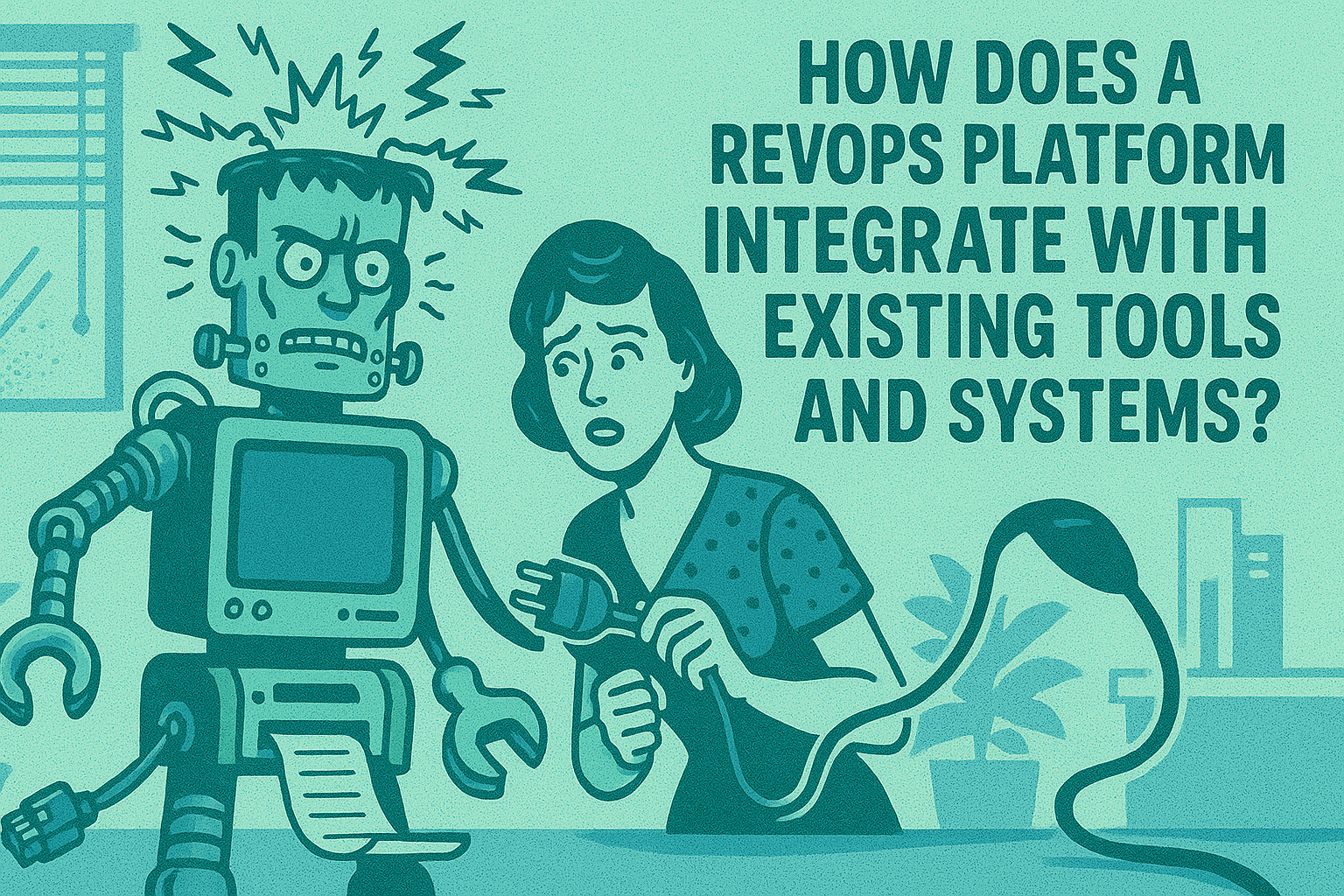
This isn’t because teams are incompetent. It’s because most tools were added reactively—one for lead scoring, one for outbound automation, one for customer onboarding, one for support tickets, one for analytics, one for product telemetry, one because a VP saw a cool demo and panicked. Over time, the stack becomes a Frankenstein monster built by multiple generations of revenue leaders, each adding their own limbs without checking whether the creature already had too many. And now, every time you try to move a data point between systems, it gets lost like a child wandering at Disneyland.
Your stack doesn’t need more tools.
It needs a translation layer—a system that forces all these disconnected creatures to stop screaming into the void and work together like adults.
And that, in all its dramatic glory, is what a RevOps platform does.
The Clear Definition: What “Integration” Actually Means
Integration means enabling all your revenue systems—CRM, MAP, CS platforms, product analytics, billing, BI tools, and anything else you impulsively subscribed to—to function together within a single operational architecture governed by consistent rules, shared data, and unified lifecycle logic.
Said another way:
Integration isn’t just “the fields sync.”
Integration is “the entire revenue engine finally speaks a single language and stops behaving like warring kingdoms.”
A RevOps platform doesn’t replace your systems. It coordinates them, like a conductor standing in front of an orchestra made up entirely of musicians who previously refused to play the same song.
Why Your Current Integrations Aren’t Working (Even If Everyone Pretends They Are)
Most integrations technically exist—they’re turned on, there’s an API key somewhere, and if you stare at the logs long enough you’ll see a heartbeat. But functioning is not the same as working. A patched-together Google Sheet, a Zapier widget, and a hundred conditional sync rules do not create an integrated system. They create illusions—illusions that everything is fine until the moment your company needs accurate data, real-time updates, or explanations for why Marketing’s numbers contradict Sales’, which contradict CS’, which contradict Finance’s spreadsheet of inconvenient truth.
Integrations fail because they only move data between silos—they don’t reconcile, validate, normalize, or interpret that data. One system calls something an “account,” another calls it a “company,” a third calls it a “customer,” and a fourth calls it “the reason everything is broken.” Fields don’t match. Lifecycle stages don’t match. Definitions don’t match. And the only thing consistent across your systems is the mounting confusion.
When tools aren’t architected to function as one strategic ecosystem, you don’t have integration—you have digital diplomacy, and you’re losing the negotiations.
A RevOps platform ends the chaos by defining, enforcing, and protecting a unified operational model that governs every tool in the stack.
How a RevOps Platform Actually Integrates With Your Existing Tools (Without Burning Everything Down)
A RevOps platform doesn’t require you to start over, migrate everything, or perform open-heart surgery on your CRM. Instead, it becomes the central nervous system that coordinates every moving part of your revenue operations. Systems that used to operate independently suddenly behave like nodes in one intelligent machine.
The platform connects to your CRM, listens to lifecycle changes, and validates whether the data entering the CRM actually meets your definitions. It pulls real-time engagement signals from your marketing automation platform and translates them into actionable intelligence for Sales. It takes product usage data—historically trapped in engineering’s cave—and turns it into customer health and expansion signals for CS. It connects billing information so Finance isn’t relying on its own isolated truth. It unifies everything into one coherent picture where the customer journey finally appears as a single story instead of a series of disjointed diary entries written by different authors who never met each other.
Where a normal integration simply moves data from one system to another, a RevOps platform governs how that data is used, what rules apply to it, how it changes lifecycle stages, and which actions it triggers. This is not connectivity.
This is operational orchestration.
Why Integration Is the Foundation of Operational Maturity (and Not Just a “Nice-to-Have”)
Operational maturity does not happen because you have great people. It happens because your systems amplify those people instead of sabotaging them. When your tools aren’t integrated, your teams waste hours hunting for information, duplicating work, re-entering data, fixing sync issues, and reconstructing customer context that should have been handed to them automatically. This is not “work”—it’s a tax on productivity, morale, and revenue.
True integration—the kind delivered by a RevOps platform—reduces friction across the entire revenue engine. Sales receives context the moment a lead becomes a human. Marketing receives feedback on which campaigns drive actual revenue, not just clicks. CS receives an onboarding experience that isn’t cobbled together from mismatched data fields. Finance sees ARR and pipeline signals they can actually trust. Product receives insight into which features influence retention and expansion. Leadership receives visibility into the entire engine without needing seven dashboards and a prayer candle.
Integration is the mechanism by which the revenue engine becomes reliable, predictable, scalable, and strategically intelligent. Without it, you’re just pouring money into tools that don’t talk to each other and hoping the resulting chaos somehow scales.
Spoiler: it won’t.
A Real-World Story: The Company Whose Stack Finally Stopped Fighting Itself
Picture a scaling SaaS company with every tool imaginable—a CRM, MAP, SEP, onboarding tool, product analytics platform, billing system, BI layer, and three different CS tools because each director inherited one. They were so proud of their stack. The problem? Nothing worked together. Leads disappeared between systems like a magician’s trick. Product usage data was visible only to an engineer named Tyler. Deals entered the CRM missing half their fields because upstream tools didn’t sync properly. CS never got updated customer context. Marketing didn’t know which efforts led to revenue. And Finance’s ARR forecast was based on a spreadsheet that contradicted every other dashboard in the building.
Then they implemented a RevOps platform.
The transformation wasn’t instant like magic—but it was immediate like truth. Data flowed consistently. Lifecycle stages matched across tools. Sales received enriched account intelligence automatically. CS onboarded customers with full visibility. Marketing finally received real revenue attribution. Finance stopped hunting ghosts in the numbers. Product connected usage patterns to revenue outcomes. Leadership saw everything in one unified system.
The tech stack didn’t change.
The operating system did.
And suddenly the stack behaved like it was designed intentionally rather than cobbled together by panicked humans responding to quarterly fires.
The Final Truth
Your tech stack doesn’t need more software. It needs structure.
It doesn’t need more automations. It needs orchestration.
It doesn’t need more integrations. It needs unified intelligence.
A RevOps platform integrates your existing systems by enforcing shared truth, shared lifecycle definitions, and shared operational logic that transforms disconnected tools into a cohesive, strategic revenue engine.
Integration isn’t about syncing fields.
Integration is about synchronizing purpose.
It’s about giving your tools a shared brain and giving your teams a shared reality.
Without integration, your systems fight each other.
With integration, your systems empower each other.
And the only thing in your stack capable of delivering that level of operational sanity is a RevOps platform built to tame the chaos you’ve been pretending isn’t happening.